15 Common SEO Mistakes USA Businesses Should Avoid
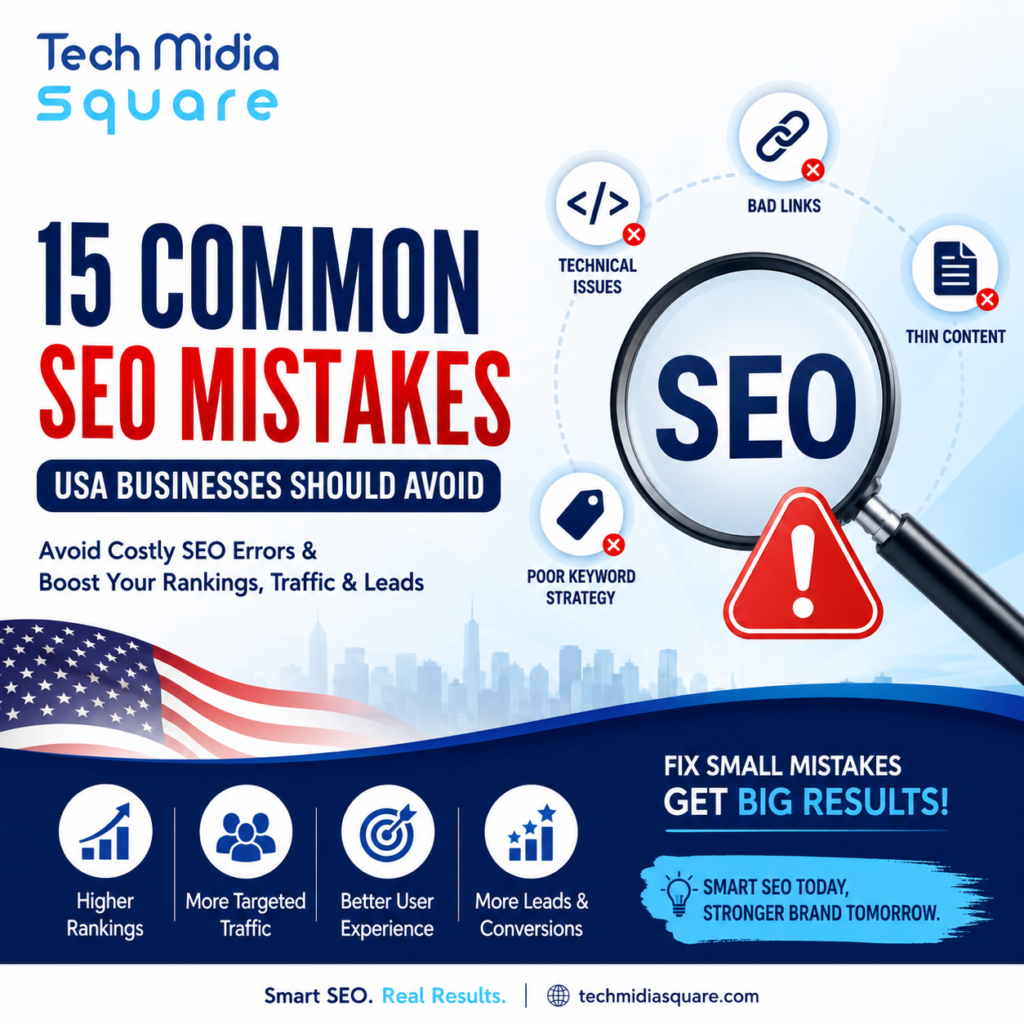
SEO can bring a steady stream of qualified customers to a business, but small mistakes can quietly hold a website back. A company may have great products, a strong reputation, and an attractive website, yet still struggle to appear when potential customers search on Google.
For USA businesses, SEO has also moved beyond traditional rankings. People increasingly search with longer, conversational questions and use AI-powered search experiences alongside traditional results. That means your website needs to be technically accessible, genuinely useful, locally relevant, and easy for both people and search systems to understand.
At Tech Midia Square, we see many of the same SEO problems repeatedly during website audits. Here are 15 common SEO mistakes USA businesses should avoid, along with practical ways to fix them.
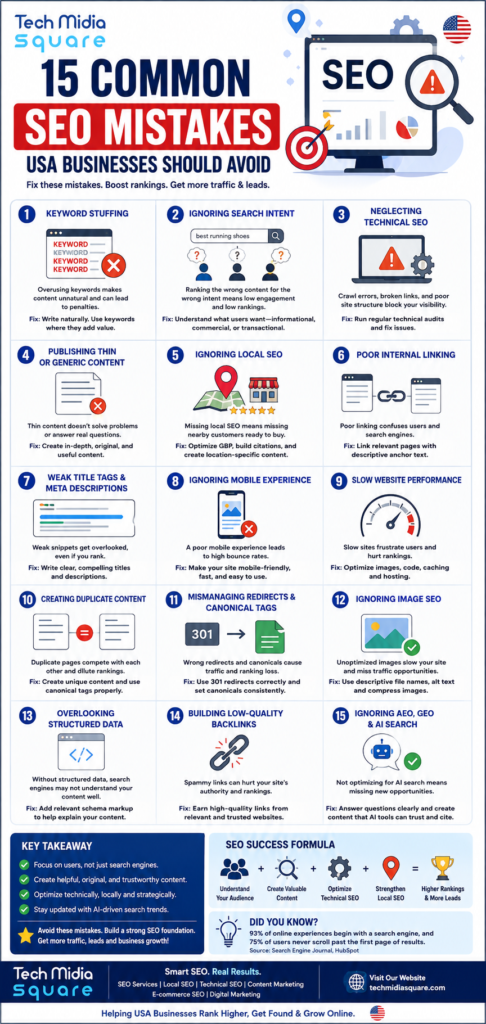
1. Keyword Stuffing
Repeating the same keyword dozens of times doesn’t make a page more relevant. It makes the content awkward and can reduce trust.
Instead, use the primary keyword naturally alongside related phrases and entities.
For example, a Chicago law firm doesn’t need to repeat Chicago SEO services in every paragraph. It can naturally discuss local search, Google Business Profile, technical SEO, content optimization, citations, and lead generation.
Fix: Write for people first and use keywords where they genuinely add context.
2. Ignoring Search Intent
One of the biggest SEO mistakes USA businesses make is targeting keywords without understanding what the searcher actually wants.
Someone searching SEO company near me may be ready to contact an agency. Someone searching “how does SEO work” is probably still researching.
Before creating a page, ask:
- Is the search informational, commercial, or transactional?
- What question does the visitor need answered?
- What action should they take next?
- Does the content satisfy the query without forcing them to search again?
3. Neglecting Technical SEO
Great content won’t perform well if search engines can’t properly crawl, render, index, and understand your website.
Common technical SEO problems include:
- Broken links
- Incorrect robots.txt directives
- Poor XML sitemaps
- Indexing problems
- Missing canonical tags
- Redirect chains
- Orphan pages
- Poor site architecture
A technical SEO audit can uncover issues that aren’t obvious from the front end of a website.
4. Publishing Thin or Generic Content
Publishing hundreds of short pages isn’t automatically an SEO strategy.
A useful page should demonstrate knowledge, answer important questions, provide practical information, and offer something valuable that generic competitors don’t.
For example, instead of publishing a generic “SEO Services” page, a USA-focused agency could explain its process, target industries, local SEO approach, reporting methods, technical SEO work, and examples of problems it solves.
5. Ignoring Local SEO
For businesses serving specific cities or regions, local SEO can be a major source of qualified leads.
A dentist in Boston, a plumber in California, or a restaurant in Chicago shouldn’t rely only on a generic homepage.
Build relevant location pages, maintain accurate business information, optimize your Google Business Profile, earn legitimate local mentions, and create content that addresses local customer needs.
Tech Midia Square also provides local SEO services designed to help businesses strengthen their visibility in location-based searches.
6. Poor Internal Linking
Internal links help visitors discover related information and help search engines understand how your website’s pages are connected.
Instead of ending every article with no next step, connect relevant topics.
For example: SEO mistakes → technical SEO → local SEO → SEO services → contact
Use descriptive anchor text rather than repeatedly using phrases such as “click here.”
7. Weak Title Tags and Meta Descriptions
A page can rank and still receive few clicks if its search snippet isn’t compelling.
Your title should clearly communicate what the page offers. Your description should reinforce the value and encourage the right searcher to visit.
Avoid titles that are vague, repetitive, or overloaded with keywords.
8. Ignoring Mobile Experience
Many customers discover businesses from smartphones. If navigation is difficult, buttons are hard to tap, text is tiny, or important information is buried, visitors may leave before contacting you.
Test important pages on multiple screen sizes. Check forms, menus, images, phone numbers, and calls to action.
9. Slow Website Performance
A slow website creates friction before a visitor even reads your content.
Compress oversized images, reduce unnecessary scripts, improve hosting and caching, and monitor Core Web Vitals and other performance signals.
Website performance is especially important for businesses competing for attention on mobile devices and modern search experiences.
10. Creating Duplicate Content
Using nearly identical pages for multiple cities or services can create a poor user experience and make it difficult for search engines to determine which page deserves visibility.
If you’re creating location pages, make them genuinely useful. Include unique services, customer needs, local context, FAQs, and relevant business information rather than simply replacing a city name.
11. Mismanaging Redirects and Canonical Tags
Website redesigns, URL changes, migrations, and deleted pages can create SEO problems when redirects aren’t handled correctly.
Use appropriate permanent redirects when URLs genuinely move. Avoid redirect chains and loops, and use canonical tags consistently where duplicate or near-duplicate URLs exist.
12. Ignoring Image SEO
Images aren’t just decoration.
Large files can slow down pages, while meaningless filenames and missing alternative text can make images harder to understand.
Use:
- Descriptive image filenames
- Appropriate image formats
- Image compression
- Useful alt text when it helps explain the image
- Responsive images where appropriate
13. Overlooking Structured Data
Structured data helps search engines understand specific information on a page.
Depending on the content, relevant schema can describe organizations, products, services, articles, events, breadcrumbs, and other entities.
Don’t add schema simply because you can. It should accurately represent visible page content and follow search engine guidelines.
14. Building Low-Quality Backlinks
More backlinks don’t automatically mean better rankings.
Buying questionable links, participating in link schemes, or creating hundreds of irrelevant directory profiles can create risk without building meaningful authority.
Focus instead on earning relevant mentions through useful content, partnerships, digital PR, industry resources, and genuinely valuable contributions.
15. Ignoring AEO, GEO and AI Search
Search is becoming increasingly conversational. Users can ask complex questions and receive synthesized answers from AI-powered search experiences.
That doesn’t mean businesses should abandon traditional SEO. It means SEO content should also be structured so important information is easy to identify and understand.
How to Improve AEO and GEO Visibility
- Answer important questions directly.
- Use clear H2 and H3 headings.
- Include concise definitions and explanations.
- Add relevant FAQs.
- Demonstrate first-hand expertise.
- Support important claims with credible sources.
- Connect related pages through internal links.
- Keep business information consistent.
- Write naturally instead of producing keyword-heavy content.
A strong AI-search strategy should complement traditional SEO rather than replace it.
SEO Mistake vs. Better Approach
| SEO Mistake | Better Approach |
|---|---|
| Keyword stuffing | Natural keyword and semantic usage |
| Generic content | Original, useful, experience-led content |
| Ignoring local SEO | Location-focused optimization |
| Poor internal links | Logical topic clusters |
| Slow pages | Performance optimization |
| Weak snippets | Clear, compelling titles and descriptions |
| Low-quality backlinks | Relevant authority-building |
| Ignoring AI search | AEO and GEO-ready content |
Expert Tips From Tech Midia Square
Before publishing a page, ask these five questions:
- Does this page answer a real customer question?
- Is the information specific enough to be useful?
- Can Google easily crawl and understand the page?
- Are related pages naturally connected?
- Would a customer trust the business after reading it?
If the answer to all five is yes, you’re building a stronger SEO foundation.
Common SEO Mistakes to Check First
If your organic traffic has stalled, don’t immediately publish more content. Start with an SEO audit.
- Indexing and crawlability
- Search intent
- Existing content quality
- Internal linking
- Page speed
- Mobile usability
- Local SEO signals
- Title and meta performance
- Backlink quality
- Conversion paths
- AI search visibility
Often, improving existing pages can be more valuable than continuously adding new content.
Frequently Asked Questions
What are the most common SEO mistakes USA businesses make?
The most common include keyword stuffing, ignoring search intent, weak technical SEO, thin content, poor internal linking, neglecting local SEO, slow websites, duplicate content, and ignoring evolving AI search experiences.
How can a business improve SEO quickly?
Start with an SEO audit. Identify technical issues, pages with search impressions but low clicks, weak content, indexing problems, and missed internal-linking opportunities. Then prioritize improvements based on business value.
Is local SEO important for USA businesses?
Yes. Businesses serving specific cities or service areas can benefit significantly from local search optimization, Google Business Profile management, location-focused content, and consistent business information.
Does AI search replace traditional SEO?
No. A strong technical foundation, useful content, authority, relevance, and search intent still matter. AEO and GEO should complement traditional SEO rather than replace it.
Can Tech Midia Square help fix SEO problems?
Yes. Tech Midia Square provides SEO, technical SEO, local SEO, content marketing, and broader digital marketing solutions for businesses targeting customers across the USA.
Conclusion
SEO mistakes rarely happen because a business doesn’t care about growth. More often, they happen because SEO has become more technical, competitive, and user-focused.
The best approach is to stop chasing shortcuts and build a website that deserves visibility.
Fix technical problems. Match search intent. Create genuinely useful content. Strengthen internal links. Invest in local SEO where relevant. Improve website performance. And make your content clear enough for both users and modern search systems to understand.
For USA businesses looking for a long-term SEO strategy, Tech Midia Square combines technical optimization, content, local search, and AI-focused SEO practices to build stronger organic visibility and generate more qualified opportunities.
Ready to Improve Your SEO?
Ready to identify what’s holding your website back? Talk to Tech Midia Square about an SEO strategy built around your market, customers, and business goals.