What Are the Top-Rated AI SEO Platforms Worth Buying for E-Commerce Sites?
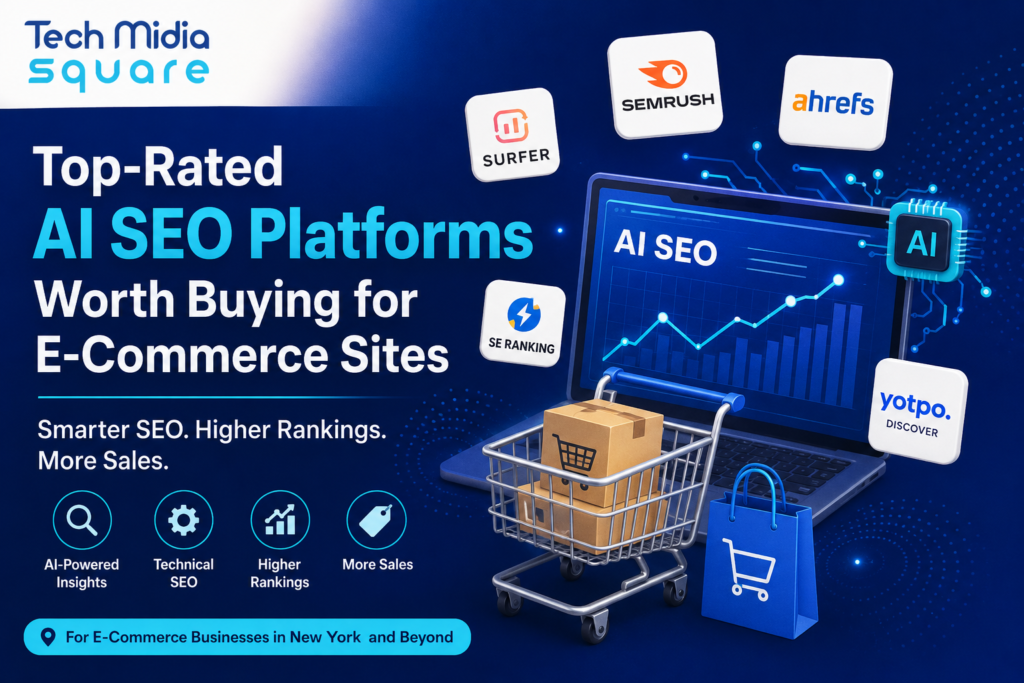
E-commerce SEO has changed. Ranking a product page on Google is still important, but online stores now need to compete across Google AI Overviews, Google AI Mode, ChatGPT, Gemini, and Perplexity.
That’s where AI SEO platforms can help.
The best AI SEO software can speed up keyword research, identify technical problems, optimize product and category pages, improve content, track competitors, and increasingly monitor how brands appear in AI-generated answers.
But not every AI SEO tool is worth paying for.
For an e-commerce business in New York, the right platform should do more than generate product descriptions. It should help turn search demand into qualified traffic, improve product discoverability, and support the broader SEO strategy.
What Makes an AI SEO Platform Useful for E-Commerce?
E-commerce websites have a unique SEO challenge: hundreds or thousands of URLs may need optimization.
Product pages, category pages, collection pages, filters, reviews, images, internal links, structured data, and inventory information all affect organic visibility.
A useful AI SEO platform should help with:
- Keyword and search-intent research
- Product and category-page optimization
- Technical SEO audits
- Content optimization
- Competitor analysis
- Internal linking opportunities
- Schema and structured-data recommendations
- Search performance tracking
- AI-search visibility monitoring
- Content and optimization workflows
More importantly, the platform should help your team make better decisions rather than simply producing more AI-generated content.
Top-Rated AI SEO Platforms for E-Commerce
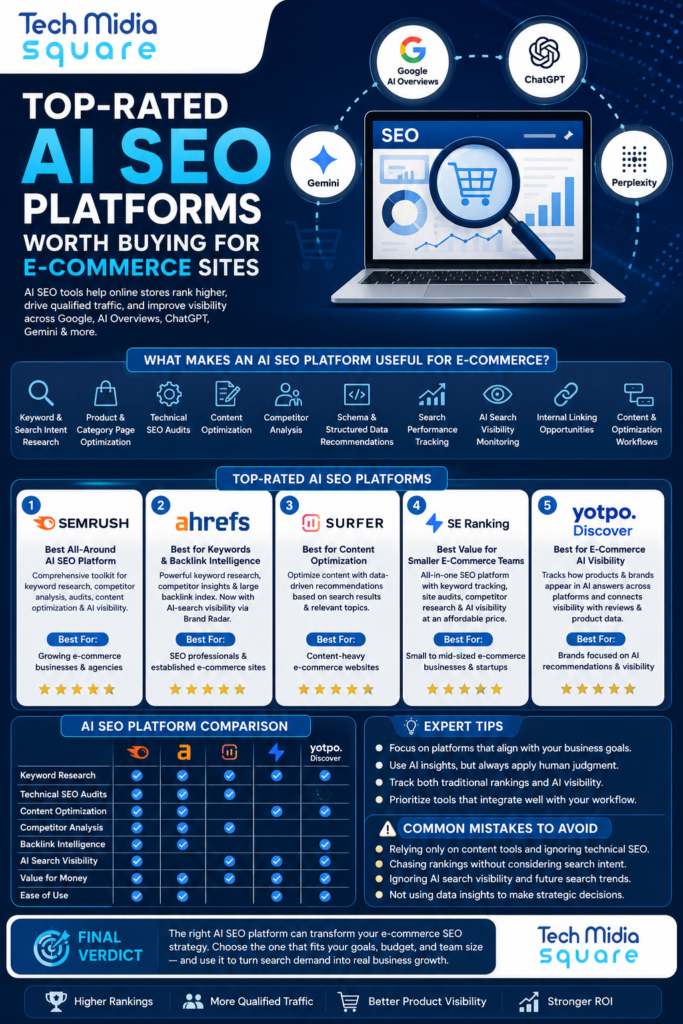
1. Semrush: Best All-Around AI SEO Platform
Semrush remains one of the strongest choices for e-commerce seo companies that want a broad SEO toolkit.
It combines keyword research, competitor analysis, site auditing, content optimization, rank tracking, and AI-search visibility capabilities.
Best for: Growing e-commerce businesses, agencies, and marketing teams.
Why consider it:
- Extensive keyword research
- Competitor and backlink analysis
- Technical SEO auditing
- Content optimization
- AI visibility monitoring
- Useful data for ecommerce SEO strategy
For example, a New York fashion retailer could use Semrush to identify commercial keywords, compare competing stores, find technical issues, and discover content gaps around high-value product categories.
2. Ahrefs: Best for Keywords and Backlink Intelligence
Ahrefs is particularly valuable when keyword research, competitor analysis, and backlink intelligence are priorities.
Its large link index and keyword data can help e-commerce marketers understand why competitors rank and which pages are attracting authority.
Ahrefs has also expanded into AI-search visibility through Brand Radar, making it relevant to businesses tracking traditional and generative search together.
Best for: SEO professionals and established e-commerce websites competing in difficult markets.
3. Surfer SEO: Best for Content Optimization
Surfer SEO is a strong option when your biggest challenge is creating and improving search-focused content.
It can help marketers optimize articles and landing pages based on search results and relevant topics.
For an online store publishing buying guides, comparison pages, and category content, Surfer can make content optimization more systematic.
Best for: Content-heavy e-commerce websites.
However, it shouldn’t replace a complete technical SEO platform. Content optimization is only one part of ecommerce SEO.
4. SE Ranking: Best Value for Smaller E-Commerce Teams
SE Ranking is worth considering when you want a broader SEO platform without building an expensive enterprise stack.
Best for: Small and mid-sized e-commerce companies, startups, and lean marketing teams.
It can be particularly useful when one person handles several SEO responsibilities and needs keyword tracking, website audits, competitor research, and visibility monitoring in one place.
5. Yotpo Discover: Best for E-Commerce AI Visibility
Yotpo Discover takes a more commerce-specific approach to generative and answer engine optimization.
Its focus is on how products and brands appear in AI-generated answers across platforms such as ChatGPT, Gemini, and Google AI Mode. The platform also connects AI visibility with ecommerce data such as reviews and product information.
Best for: E-commerce brands that want to focus heavily on AI recommendations and product visibility.
This is an important distinction: monitoring an AI mention isn’t the same as building the signals that make a product useful and credible enough to be mentioned.
AI SEO Platforms Compared
| Platform | Best For | E-Commerce Strength | AI Search Focus |
|---|---|---|---|
| Semrush | All-around SEO | High | High |
| Ahrefs | Keywords & backlinks | High | High |
| Surfer SEO | Content optimization | Medium-High | Medium |
| SE Ranking | Value & broad SEO | High | High |
| Yotpo Discover | AI visibility | Very High | Very High |
The right choice depends on your website size, budget, ecommerce platform, internal SEO skills, and primary growth goal.
How to Choose the Right AI SEO Platform
Before purchasing, ask five questions:
1. Does It Support Your SEO Workflow?
A tool should fit the way your team actually works. Don’t pay for dozens of features nobody will use.
2. Can It Handle Product and Category Pages?
A blog-focused AI tool isn’t enough for a store with thousands of products.
3. Does It Support Technical SEO?
Look for crawling, indexing, redirects, canonicalization, duplicate-content detection, structured data, and internal-link analysis.
4. Can It Measure AI Visibility?
If your goal includes GEO and AEO, look beyond traditional rankings. You should understand whether your brand appears in relevant AI-generated answers.
5. Does the Data Lead to Action?
Reports are useful, but recommendations that your SEO team can actually implement are more valuable.
Expert Tips for E-Commerce AI SEO
Don’t Automate Everything
Use AI to identify patterns and speed up research, but have experienced SEO professionals review important product and category content.
Optimize for Shoppers, Not Algorithms
Product pages should clearly answer questions about price, sizing, materials, compatibility, shipping, returns, availability, and use cases.
Build Citation-Worthy Content
AI systems need reliable information they can understand and reference. Clear answers, original insights, trustworthy sources, expert information, product facts, reviews, and well-structured pages all matter.
Strengthen Internal Linking
Connect category pages, product pages, buying guides, FAQs, and supporting content so both search engines and users can discover important pages easily.
For New York businesses, this becomes even more valuable when national ecommerce SEO is combined with location-focused strategies. A specialized New York SEO strategy can help brands build stronger visibility for both local and broader commercial searches.
Common AI SEO Mistakes
- Publishing hundreds of generic AI-written product descriptions
- Ignoring technical SEO
- Creating duplicate product and category content
- Focusing only on Google rankings
- Treating AI visibility as a replacement for traditional SEO
- Buying software without defining measurable goals
- Ignoring reviews and real customer experience
- Optimizing for keywords while neglecting search intent
AI can make SEO faster, but it doesn’t make poor strategy effective.
Frequently Asked Questions
What Is the Best AI SEO Platform for E-Commerce?
Semrush is one of the strongest all-around choices because it combines keyword research, technical SEO, competitor analysis, content optimization, and AI-search visibility. However, a specialist platform such as Yotpo Discover may be more appropriate when AI product visibility is the primary objective.
Can AI SEO Tools Improve Product-Page Rankings?
Yes. They can identify keyword opportunities, content gaps, technical problems, internal-linking opportunities, and optimization recommendations. However, rankings still depend on many factors, including relevance, technical accessibility, content quality, authority, competition, and user experience.
Do E-Commerce Businesses Need GEO and AEO?
Increasingly, yes. Customers are using AI-powered search experiences to research products and compare brands. GEO and AEO help businesses structure information so it has a better chance of being understood and surfaced in AI-generated answers.
Should I Use More Than One AI SEO Tool?
Often, yes. One platform may be excellent for technical SEO and backlinks while another is better for content optimization or AI visibility. The goal isn’t to collect tools. It’s to build a practical SEO workflow.
Final Verdict
The best AI SEO platform isn’t necessarily the one with the longest feature list.
For most e-commerce businesses, Semrush is a strong all-around choice. Ahrefs is excellent for keyword and backlink intelligence, Surfer SEO works well for content optimization, SE Ranking offers broad functionality for lean teams, and Yotpo Discover is especially interesting for brands prioritizing AI-search visibility.
For a New York e-commerce business, however, software is only one piece of the puzzle.
A stronger approach combines technical SEO, ecommerce SEO, content strategy, structured data, internal linking, conversion optimization, AEO, and GEO into one measurable strategy.
Looking to Improve Your E-Commerce Visibility?
Tech Midia Square helps businesses build search strategies designed for both traditional search and emerging AI discovery. From ecommerce SEO services and technical optimization to AI SEO services, content strategy, and local search visibility, the focus is on creating sustainable organic growth rather than simply generating more content.
If your New York e-commerce business is getting impressions but not enough qualified clicks or conversions, the first step is to identify where the visibility gap actually exists, then build the right SEO workflow around it.
Ready to improve your e-commerce search visibility? Explore Tech Midia Square’s SEO solutions and build a strategy designed for Google Search, AI search, and customers who are ready to buy.