Transform Your Email Marketing with AI: A Smarter Digital Marketing Strategy for New York Businesses
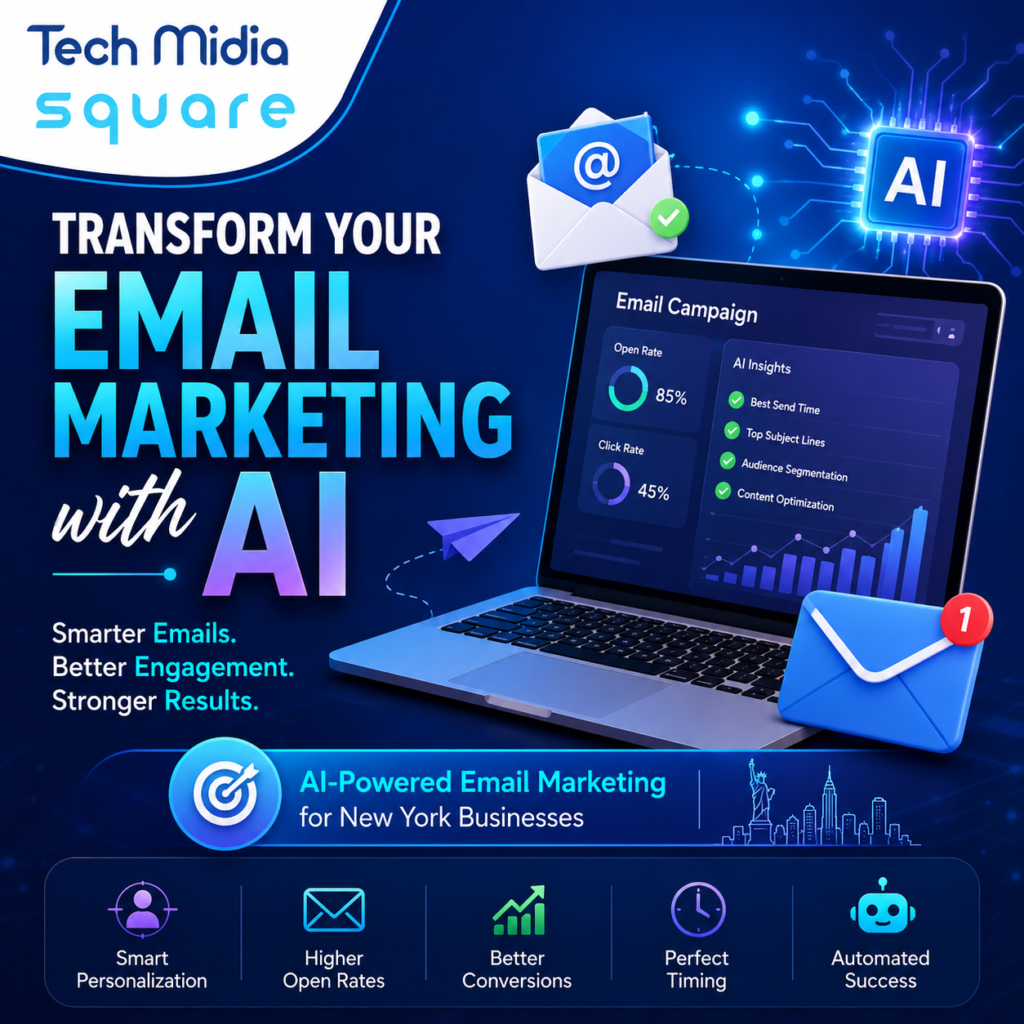
Email marketing still works, but the way people expect brands to communicate has changed.
A New York customer may receive dozens of promotional emails in a single day. A generic subject line and mass email aren’t enough to earn attention anymore. This is where artificial intelligence can make a real difference.
AI can help businesses analyze customer behavior, personalize campaigns, predict engagement, improve subject lines, automate follow-ups, and deliver more relevant messages at the right time.
For businesses investing in digital marketing, AI-powered email marketing can turn email from a simple communication channel into a measurable customer acquisition and retention tool.
At Tech Midia Square, we help businesses combine digital marketing, SEO, content marketing, AI marketing, and conversion-focused strategies to build stronger online visibility and customer journeys, particularly for competitive markets such as New York.
Table of Contents
- What Is AI-Powered Email Marketing?
- How AI Is Transforming Email Marketing
- AI Email Marketing vs. Traditional Email Marketing
- How to Use AI in Your Email Strategy
- Expert Tips for Better Results
- Common Mistakes to Avoid
- Frequently Asked Questions
- Conclusion
What Is AI-Powered Email Marketing?
AI-powered email marketing uses artificial intelligence and machine learning to analyze customer data and improve how email campaigns are planned, created, personalized, delivered, and measured.
Instead of sending the same message to every subscriber, AI can help marketers understand differences between audiences.
For example, a New York e-commerce company could identify customers who regularly browse products but don’t purchase. Instead of sending them another general newsletter, the business could create a personalized email featuring products related to their browsing behavior.
That small change can make the message feel more useful and less like advertising.
AI doesn’t replace marketing strategy. It helps marketers make better decisions with the data they already have.
How AI Is Transforming Email Marketing
1. Smarter Personalization
Personalization goes beyond adding someone’s first name.
AI can analyze information such as:
- Previous purchases
- Browsing behavior
- Email engagement
- Product interests
- Purchase frequency
- Location
- Preferred content
- Customer lifecycle stage
This allows businesses to create more relevant email experiences.
For example, a New York fitness brand could send different campaigns to new subscribers, active customers, inactive customers, and high-value members instead of treating everyone the same.
2. Better Subject Lines and Email Copy
AI tools can help marketers generate and evaluate multiple subject-line variations.
However, the goal shouldn’t be to create clever copy simply for clicks. The strongest subject line should accurately represent the value inside the email.
A practical approach is to test variations around:
- Customer pain points
- Benefits
- Curiosity
- Urgency
- Specific offers
- Personalized messaging
Then use actual campaign data to determine what resonates with your audience.
3. Predictive Customer Behavior
AI can identify patterns that aren’t always obvious from basic analytics.
It can help predict which subscribers may:
- Make another purchase
- Stop engaging
- Respond to an offer
- Need a reminder
- Become high-value customers
That information can support better segmentation and lifecycle marketing.
4. Automated Email Journeys
AI can make automated campaigns more responsive.
Instead of creating one fixed sequence, marketers can use customer behavior to determine what happens next.
A simple journey might look like:
Website visit → Email signup → Welcome email → Product interaction → Personalized follow-up → Purchase → Customer retention campaign
This connects email marketing with broader digital marketing strategies, including SEO, paid advertising, website optimization, and conversion rate optimization.
AI Email Marketing vs. Traditional Email Marketing
| Area | Traditional Email Marketing | AI-Powered Email Marketing |
|---|---|---|
| Personalization | Basic | Behavior-based |
| Segmentation | Manual | Data-driven |
| Content Creation | Mostly manual | AI-assisted |
| Timing | Pre-scheduled | Can be behavior-driven |
| Analysis | Campaign-level | Predictive and granular |
| Optimization | Manual testing | Data-supported optimization |
| Customer Journey | Often linear | More adaptive |
The important point is that AI shouldn’t eliminate human judgment. It should give marketers better information and more time to focus on strategy, creativity, and customer relationships.
How to Use AI in Your Email Strategy
Start with your customer data rather than the AI tool.
Step 1: Define the Goal
Decide what you’re trying to improve.
Is the goal to increase:
- Email signups?
- Product sales?
- Repeat purchases?
- Event registrations?
- Customer retention?
- Website traffic?
A clear goal makes AI recommendations more useful.
Step 2: Segment Your Audience
Don’t send every campaign to your entire database.
Create meaningful groups based on customer behavior and intent.
Step 3: Create Useful Content
Use AI to support brainstorming, personalization, subject-line testing, and campaign variations.
But review everything before publishing. Brand voice, accuracy, context, and customer experience still require human oversight.
Step 4: Connect Email With Other Marketing Channels
Email shouldn’t operate in isolation.
For example, someone who discovers a business through Google Search might visit a landing page, download a guide, subscribe to an email list, and eventually become a customer.
That makes email one part of a broader digital marketing strategy.
For New York businesses, combining email with local SEO, SEO services, content marketing, social media marketing, PPC, and AI marketing can create a more connected customer acquisition funnel.
Step 5: Measure Business Results
Don’t focus only on open rates.
Track metrics such as:
- Click-through rate
- Conversion rate
- Revenue per email
- Unsubscribe rate
- Customer acquisition cost
- Repeat purchases
- Lifetime customer value
The best campaign isn’t necessarily the one with the highest open rate. It’s the one that contributes to meaningful business outcomes.
Expert Tips for AI Email Marketing
- Keep personalization useful. Customers should feel understood, not monitored.
- Use first-party data responsibly. Collect and use information transparently and follow applicable privacy requirements.
- Test before scaling. Start with a smaller audience and compare results.
- Keep human oversight. AI-generated content can contain inaccurate claims, awkward language, or messaging that doesn’t fit your brand.
- Build for mobile users. Many customers read email on their phones, so keep copy concise, make CTAs obvious, and use responsive layouts.
- Create original insights. Google’s guidance emphasizes helpful, reliable, people-first content rather than content created primarily to manipulate search rankings.
This principle also matters when creating content around AI marketing. Don’t simply repeat generic AI advice. Add real examples, practical experience, original analysis, and information that helps the reader make a decision.
Common Mistakes to Avoid
Using AI Without a Strategy
AI can’t fix a campaign that doesn’t have a clear audience, offer, or objective.
Sending Too Many Emails
Automation makes it easy to increase frequency. That doesn’t mean you should.
If every customer receives multiple promotional messages each week, engagement can quickly decline.
Over-Personalization
Using too much customer data can make an email feel uncomfortable rather than helpful.
Ignoring Deliverability
Great content won’t matter if emails don’t reach inboxes. Maintain clean lists, monitor engagement, and follow responsible email practices.
Publishing AI Content Without Review
AI should assist your marketing team, not become an unchecked publishing system.
Frequently Asked Questions
How can AI improve email marketing?
AI can improve email marketing by supporting personalization, audience segmentation, content creation, predictive analysis, campaign automation, and performance optimization.
Is AI email marketing suitable for small businesses?
Yes. Small businesses can start with simple applications such as automated welcome emails, customer segmentation, personalized recommendations, and subject-line testing.
Can AI replace email marketers?
No. AI can automate repetitive tasks and identify patterns, but marketers still need to define strategy, understand customers, protect brand voice, review content, and make business decisions.
How does AI email marketing fit into digital marketing?
Email can work alongside SEO, content marketing, PPC, social media, local SEO, and conversion optimization. Together, these channels can move prospects from discovery to conversion and retention.
Can AI help New York businesses improve customer engagement?
Yes. Businesses serving New York audiences can use behavioral data and segmentation to create more relevant campaigns for different customer groups, locations, interests, and stages of the buying journey.
Conclusion
AI is changing email marketing from a one-size-fits-all communication channel into a more intelligent and personalized part of the customer journey.
The biggest opportunity isn’t simply using AI to write emails faster. It’s using customer data, automation, personalization, and analytics to make every interaction more relevant.
For businesses in New York, that can be especially valuable in crowded markets where customers have plenty of choices.
Tech Midia Square helps businesses build integrated digital marketing that connect SEO, content, AI marketing, email, paid campaigns, and conversion-focused experiences.
If you’re ready to make your marketing more intelligent, measurable, and customer-focused, explore how Tech Midia Square can help strengthen your digital presence and turn more online interactions into business opportunities.
Start building a smarter digital marketing strategy for your New York business today.